Is your Claude investment working, and is it under control?
Claude Control Tower answers that for the leaders who bought Claude, and shows every person with a seat how to use it better. One tool, running read-only inside your own Azure subscription. Chat text is never stored.
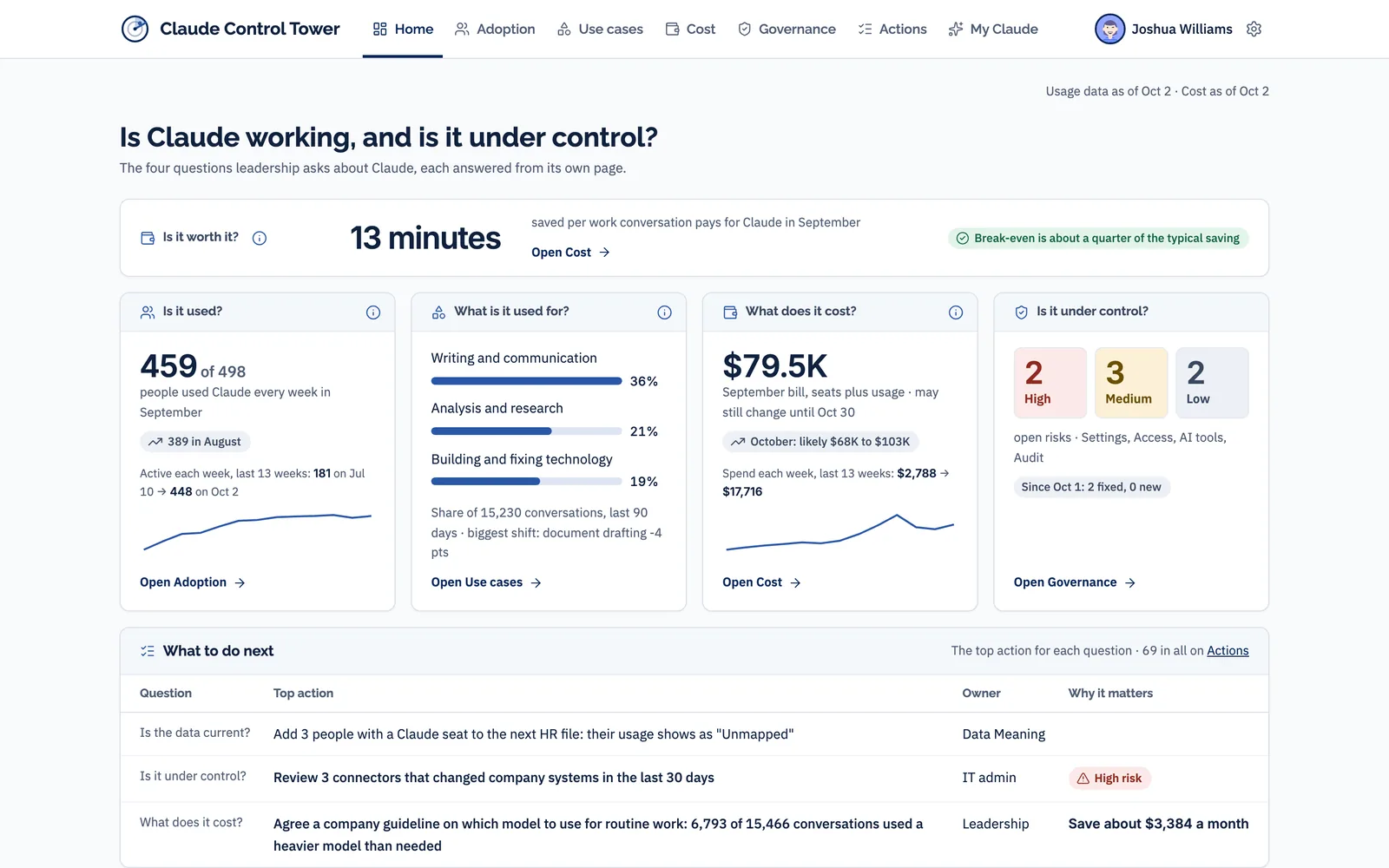
Every screen on this page shows Halvane Industries, a fictional 500-person company built for demonstration.
The board asks “is it working?” The honest answer is a usage chart.
| What goes unanswered | What it costs |
|---|---|
| What did the spend buy? | The renewal, or the next expansion, gets argued on faith. Leaders do not trust self-reported time savings, so a survey does not settle it. |
| Which seats are idle? | Seats paid for every month that nobody opens. |
| What does each department cost? | No chargeback, so no department owns its spend. One large company spent its full-year AI budget in four months. |
| Is the setup under control? | A gap found by an auditor, a customer questionnaire or an incident, instead of by you. |
| Are people getting better at it? | Most of the workforce uses AI only occasionally. Seats used shallowly cost the same as seats used well. |
What it looks like from the inside
The leader who has to answer for it
Usually a Chief AI Officer or the head of an AI center of excellence.
- The bill arrives as one number. Seats, Claude Code and the apps running on API keys come from different reports, so nobody can say what each department costs.
- Somebody builds the monthly report by hand, stitching three exports to an HR list that is already out of date. The native export only goes back 90 days.
- Nobody can say whether the setup is safe. Is single sign-on enforced? Who are the admins, and are they still here? Which connectors can write into other systems?
- There is no list of what to do next. Reclaim idle seats or fix the retention setting first?
Every person with a seat
They do not sign anything. But whether the investment works is decided by them, one conversation at a time.
- They do not know what they are missing. They use Claude for the two or three things they discovered in the first week.
- They pick the most powerful model for everything, including tasks a lighter one handles just as well.
- They never see the good stuff others found — the colleague’s skill that saves an hour a week, the public repo built for exactly their kind of work.
- They have no idea how they compare, so there is no pull to get better, and Claude stays a slightly faster search box.
Each tool answers one question for one audience
Free, and good at activity, seats and spend. It does not show what the work was, join to your org chart, score your setup against policy, or say what to do next.
Splits the bill well. It never reads a conversation, so it can say what Claude cost and never what it was used for.
Scans for sensitive data leaving the company. It has no idea what anything cost, and it is built to catch people, not help them.
People enjoyed it, used Claude more for two weeks, and drifted back. Training is a single event. Getting better is a habit.
Claude Control Tower does both, from the same data, in one place.
Six pages. Answered in a meeting, without preparing.
One tile per question, plus the top five actions.
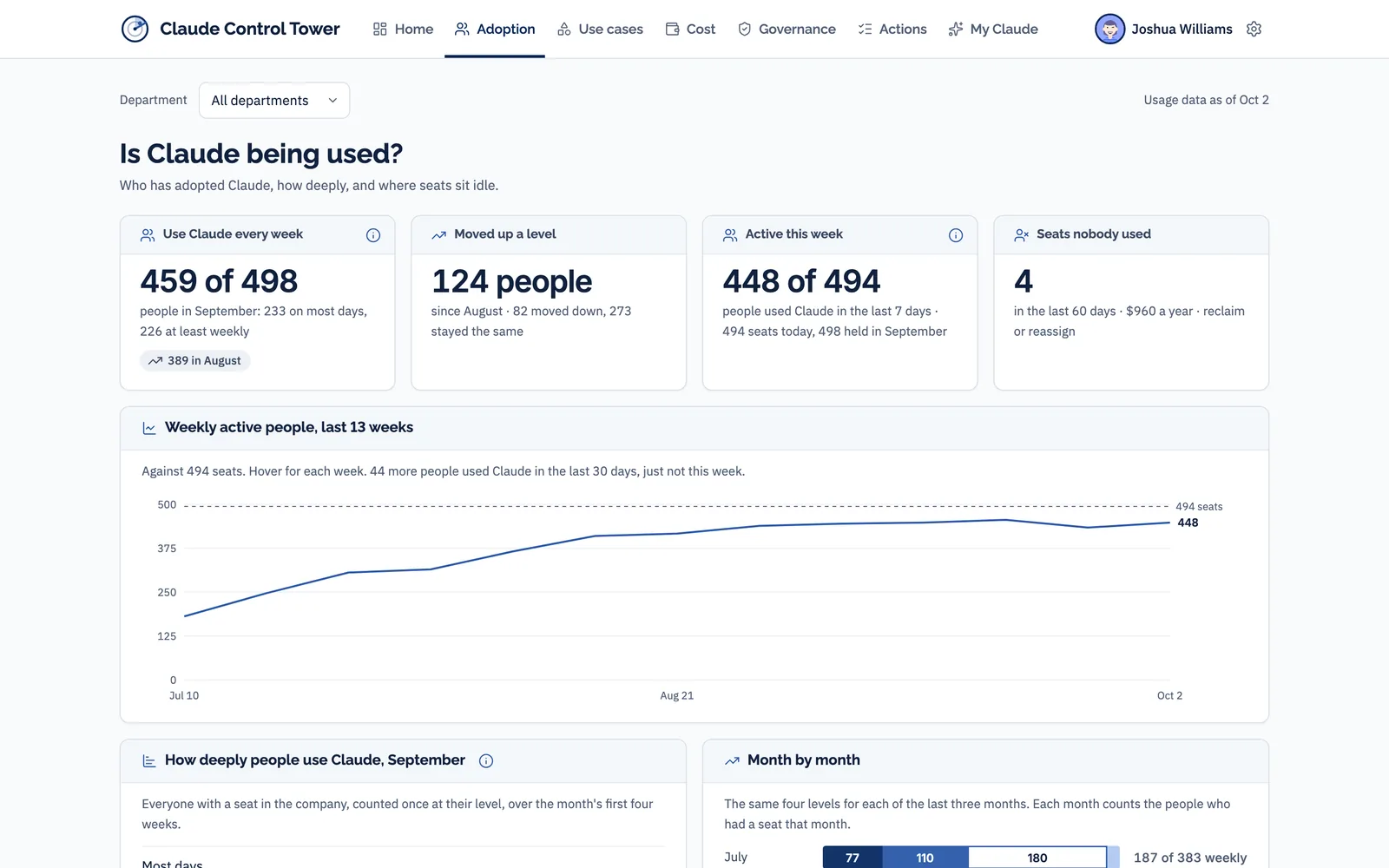
Active people by department, how deeply, idle seats, and champions.
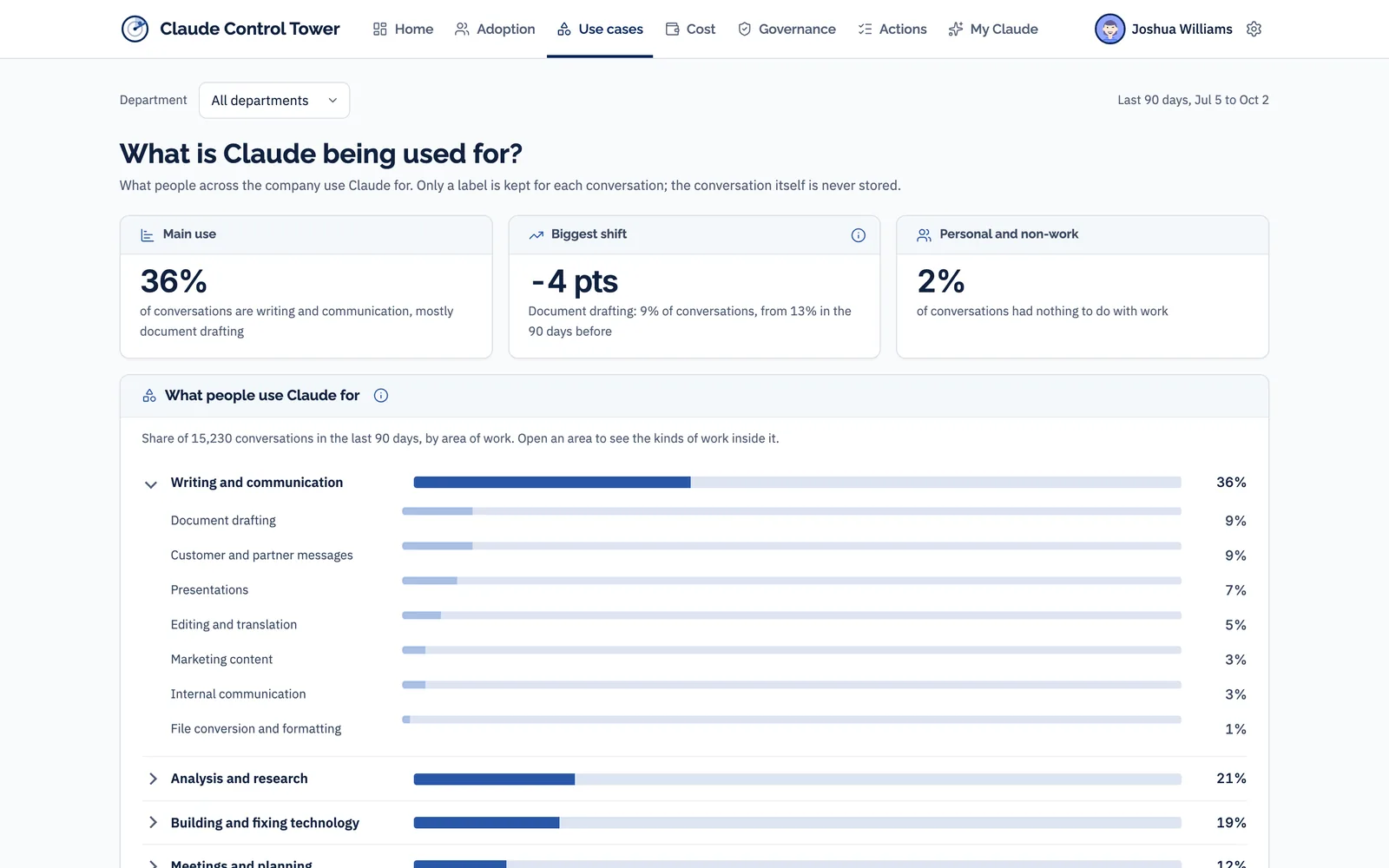
The kinds of work each department actually does with Claude.
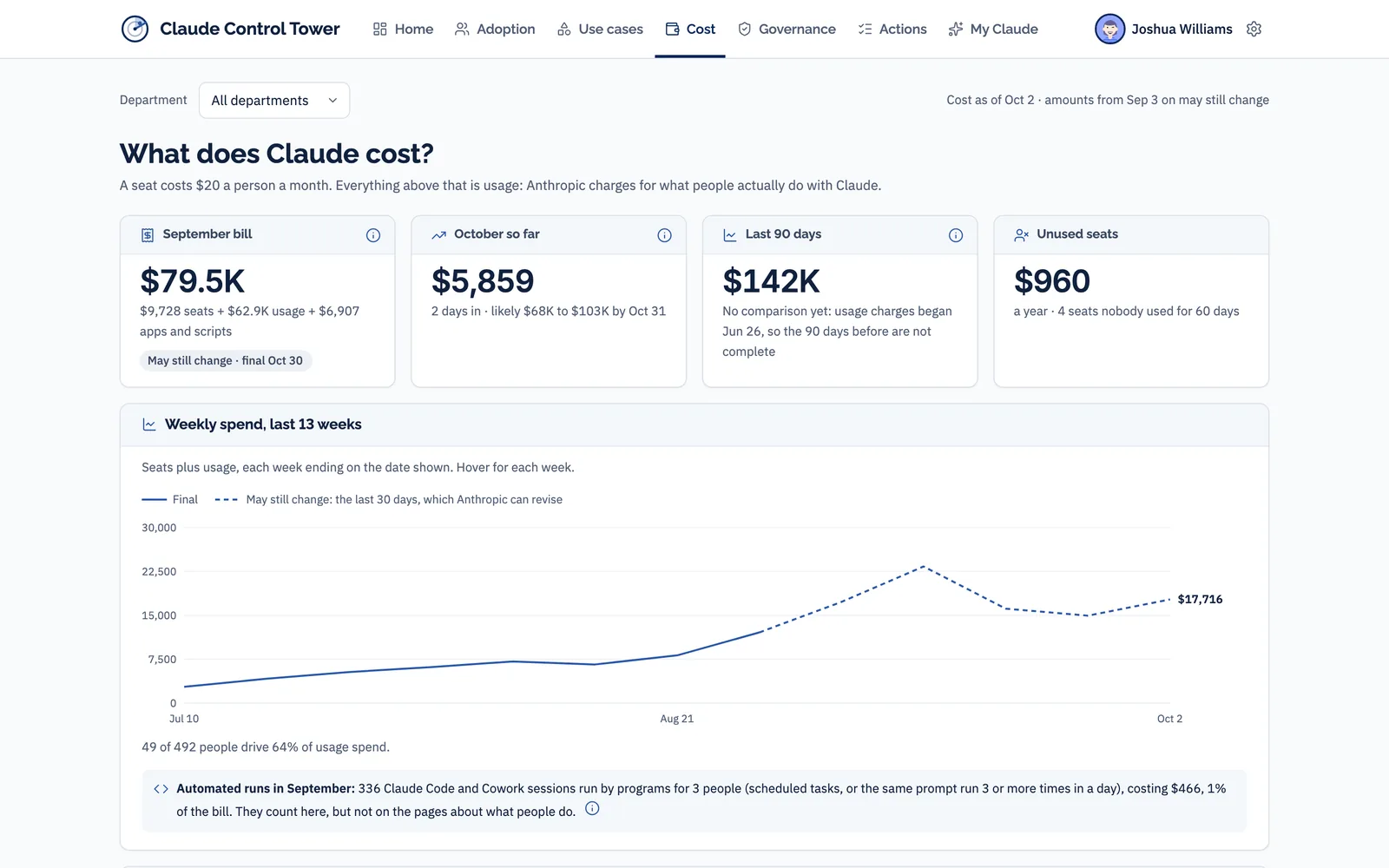
The bill by department and person, a monthly chargeback file, and the waste named in dollars.
A score out of 100 against your own policy, with the fixes that would raise it.
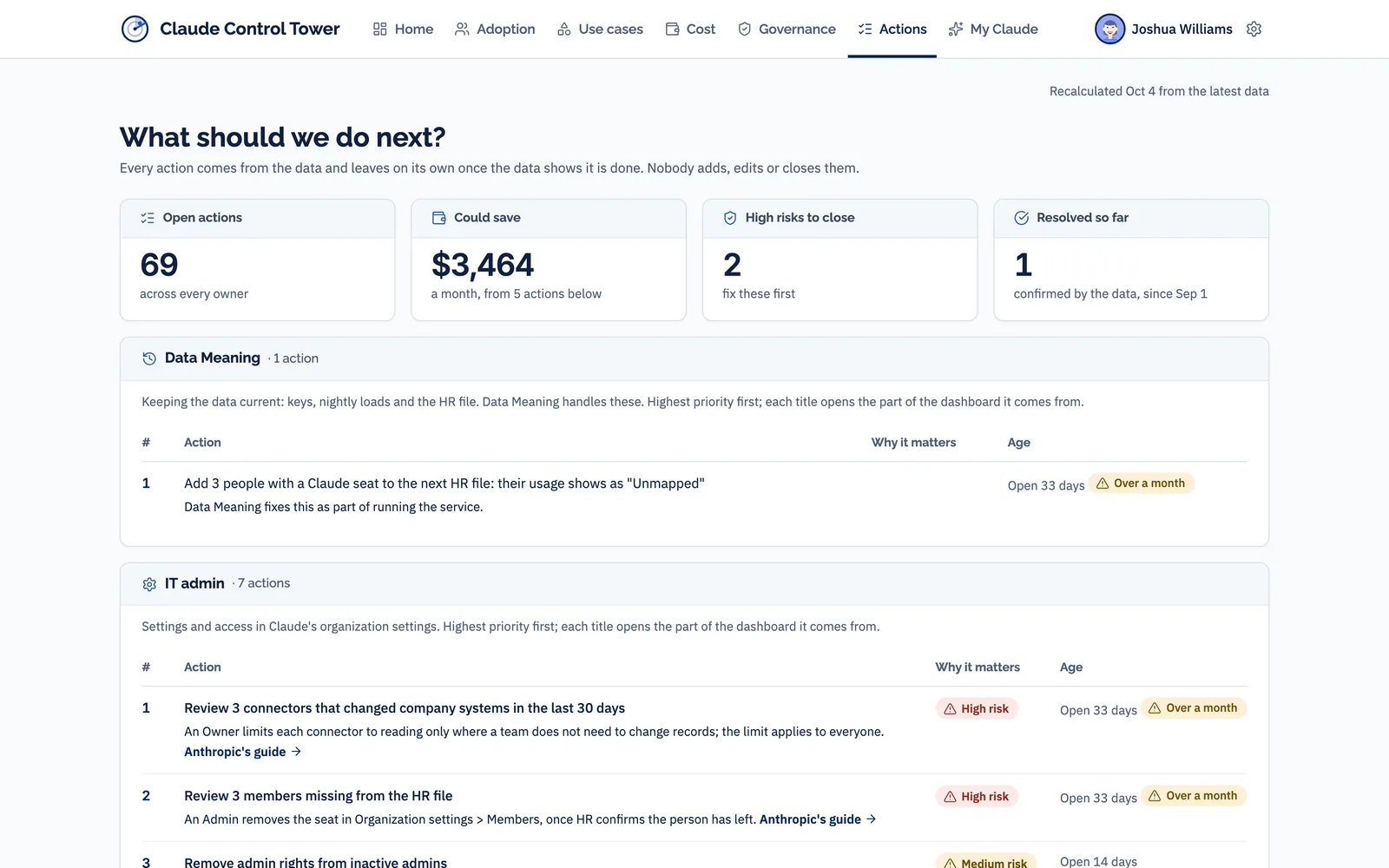
One ranked list, each action with the money it saves or the risk it closes.
Managers see the same pages for their own team only. Leaders can also ask the same questions from Claude chat, and get the same number the page shows — every figure comes from one shared definition, so the two can never disagree.
My Claude: learn, discover, and compete with colleagues
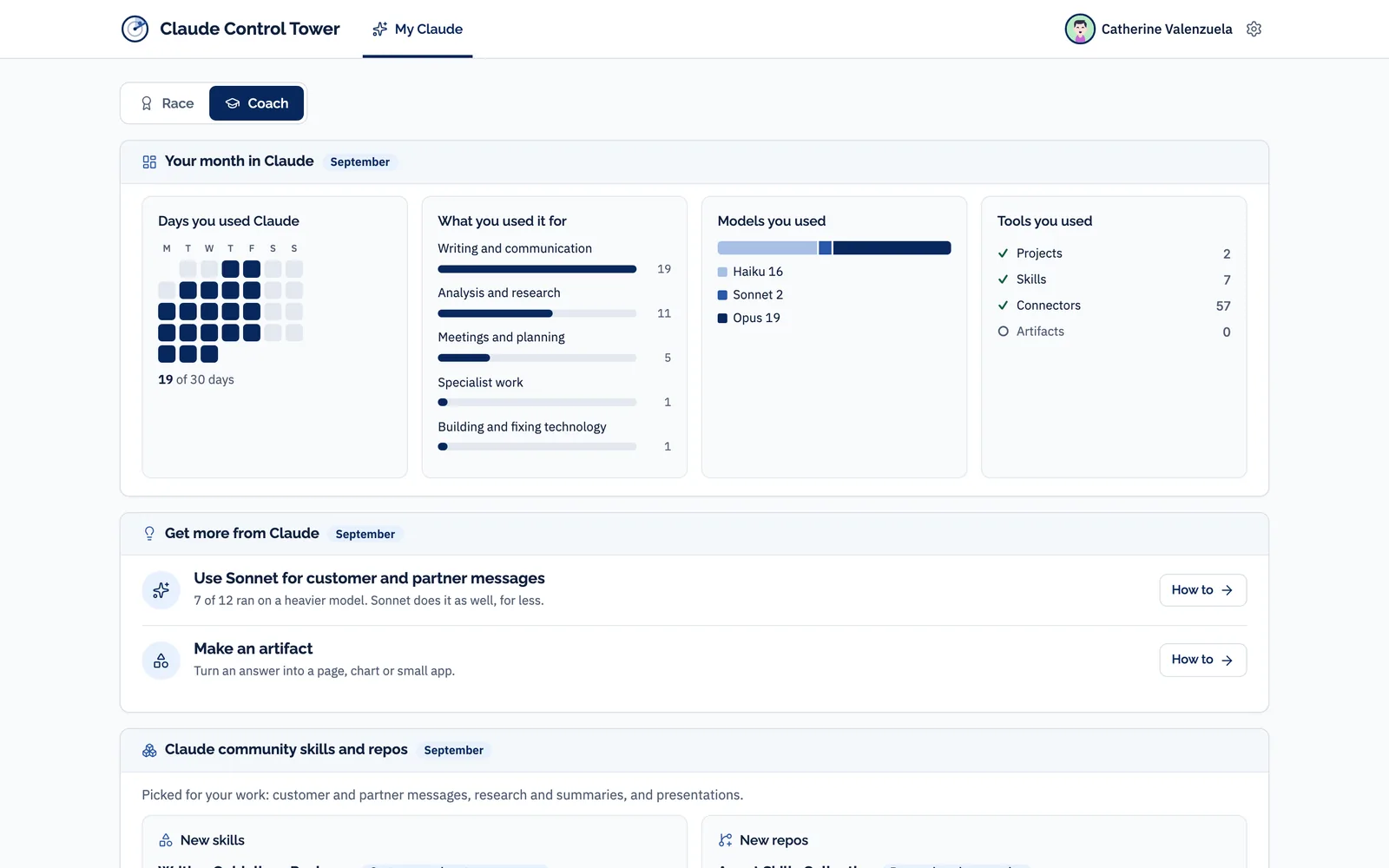
Every person with a seat signs in and sees their own month: how they used Claude, against the company, without anyone else being named.
- Coach. A few specific tips on what to try next, drawn from their own use rather than a generic course.
- Community skills and repos. Picks that fit the work they actually do, refreshed every month.
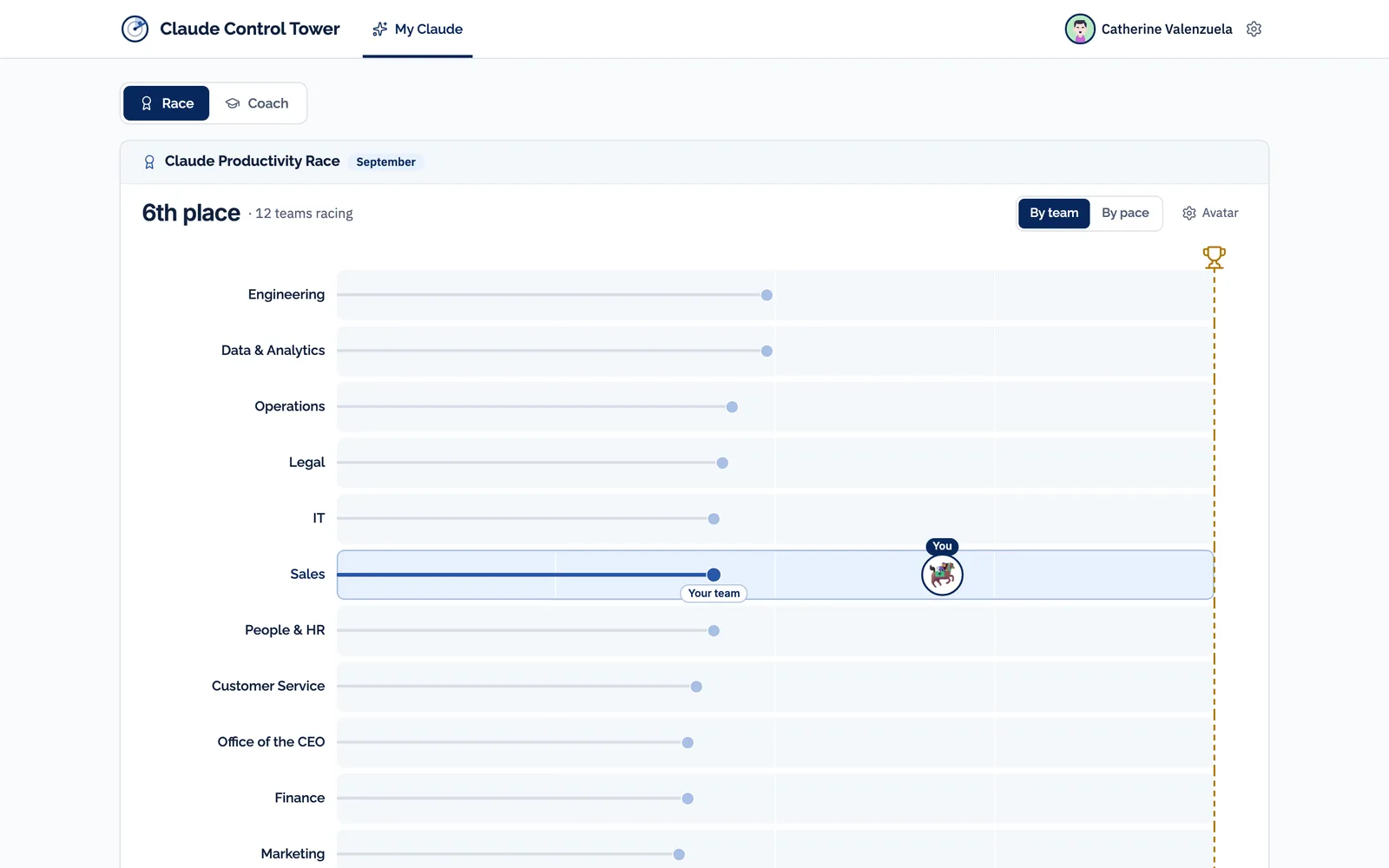
- Race. A monthly race between teams that rewards using Claude well, not just using it more. It gives people a reason to come back each month without being told to.
My Claude is built to help people, never to grade them. It does not feed performance reviews.
In your cloud. Read-only. Chat text never stored.
Claude Control Tower is already built. We install it into your own Azure subscription from a template your IT team can read before it runs. Nobody can change your Claude setup through it.
Chat text is read only to decide what kind of work it was, and only the label is kept. The database has no column that could hold chat text, and that is tested automatically. Labeling runs on Claude under your own Anthropic account, so your data stays under the agreement you already have.
| Your privacy and security team will ask | The answer |
|---|---|
| Where does the data live? | In your Azure subscription. Data leaves only as read calls to Anthropic, labeling calls to Claude, and a monthly public search for skills and repos that carries kinds of work, never people. |
| What is never kept? | Chat text, file contents, IP addresses, device details, and any emotion or sentiment judgment about a person. |
| Who sees what? | Four roles. Leaders see totals, managers see their own reporting line, and members see only their own My Claude page. Admins see names only where a list needs them. |
| Small groups? | No group under 5 people is shown on its own, anywhere. The one exception is a department’s own bill, seen only by admins, leaders and that department’s manager. |
| What can it change? | Nothing. Keys carry read scopes only, and a key with a delete scope is itself flagged as a finding. |
| Is access logged? | Every question asked of the product, and every page view once sign-in is on, goes to an access log nobody can edit. |
| What happens when we stop? | You receive the full access log, and everything is deleted within 30 days, with written confirmation. |
How you buy it
Ready, installed, reviewed
- Readiness: the checklist, plus a privacy pack and employee notice for your Legal team to approve
- Claude Control Tower installed in your Azure subscription, about one week once readiness is done
- Six dashboard pages, My Claude for every seat holder, and asking from Claude chat
- Every chat and session since your Compliance API was enabled, labeled by kind of work, with accuracy checked on a random sample of 100
- A go-live walkthrough for admins and leaders
- Four quarterly value reviews
Renewal
- Continued use of Claude Control Tower, refreshed every night
- Four quarterly value reviews: what moved, which actions resolved, and next quarter’s top actions agreed
- Label accuracy re-checked every quarter
- Configuration changes agreed in each review, live by the next nightly run
No software license fee. You pay Anthropic for labeling and Azure for hosting directly, on your own bills. Nobody at your company has to run it: Data Meaning holds the configuration, your only ongoing task is keeping the HR file current, and the quarterly review is where the numbers turn into decisions.
What you need, and when it is not for you
You need
- Claude Enterprise on Anthropic’s own service, with the Compliance API turned on
- An Azure subscription to install into
- A US workforce
- Legal approval for Claude to read chats in order to label them
- An HR file of every employee with a department and a manager
It is not for you if
- You run Claude only through Amazon Bedrock or Google Vertex
- Your deployment is in the EU, or a works council must approve
- You want to rank or discipline named individuals
- You want a data loss prevention or chat review tool
- You want custom dashboards, Power BI, or several AI providers in one view
What leaders ask us first
Anthropic already gives us a free dashboard.
Our BI team can build this from the APIs.
Our IT won’t let an outside firm install something in our cloud.
How do we know the “what for” labels are right?
Why quarterly reviews? Just give us the software.
Will people actually use My Claude?
Do you use it yourselves?
Answer “is it working?” with more than a usage chart.
Bring your seat count and last month’s bill. We’ll show you what Claude Control Tower would tell you about both.
Data Meaning is an independent consultancy. Claude is a product of Anthropic, PBC.